Travelblog #15: Ubud – Bali, Indonesia

28th-30th September, 2014

We arrived at Bali airport quite late at night and, as predicted, were caught within a swarm of Australian surfers on their way to the beach. It took Roy a while to explain to the taxi drivers that we had no wish to pay for our fare in Australian dollars…

We went straight to Ubud, which is claimed by some to be “The New Age Capital of the World”. That wasn’t the reason that we were heading there, though; it also just happens to be a great base for exploring some of Bali’s temples.

The first thing we noticed about Bali is how they like to beautify everything. Murals line the streets, and even the facades to the humblest of homes have an arched entrance with a pair of statues.

???????????????????????

While looking for a place to stay we discovered that nearly every guest house has an inner courtyard which could almost be a temple in itself, and we were only looking at the cheap ones. Balinese simply don’t do the uber-cheap, squalid accommodation that we usually end up staying in, because to create a space like that is just not within their mentality. In the end we settled upon hiring our own chalet which had two beds, a private bathroom, a fan, free wifi and a balcony.

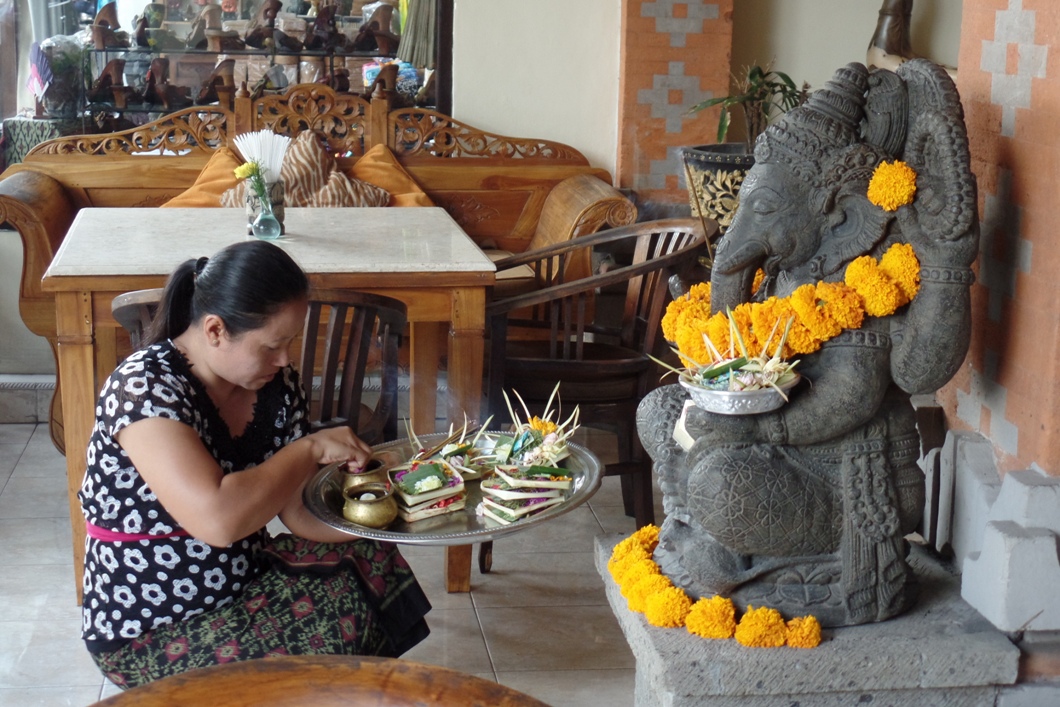
The next morning we finally saw Bali in the daylight, and while we were eating breakfast we witnessed the owner place offerings at all the statues and altars around the restaurant; a practice we would soon learn most Balinese do three times a day to thank the spirits and keep the demons at bay.

???????????????????????

Most Balinese practice their own version of Hinduism which has been fused with local animist traditions. This makes it home to some of the most interesting temples in South East Asia.

???????????????????????

Containing three temples and the usual resident gang of macaques, The Sacred Monkey Forest Sanctuary is the first point of call for most visitors to the Ubud area and is a great introduction to Balinese religion.

Many of the statues are pretty gruesome, but in an awesome way. Demons eating children and frogs playing with their “bits” are just a couple of examples of the strange iconography which is carved into the stones of Balinese religious sites. The setting of a jungle with a river rolling by was also something which made the Sacred Monkey Forest Sanctuary a very enjoyable first morning in Bali.

???????????????????????

We then went for a walk to explore some of the further reaches of Ubud, passing through some farms and smaller temples along the way. Later in the afternoon we found ourselves strolling through the streets of Penestanan district, where Bali’s population of airy expats spend their time sat in raw-foodist cafes, discussing which meditation class or yoga course is hip that week while nibbling on vegan cakes and sipping lemongrass tea. You can almost visibly see their inheritance leaking out from them.

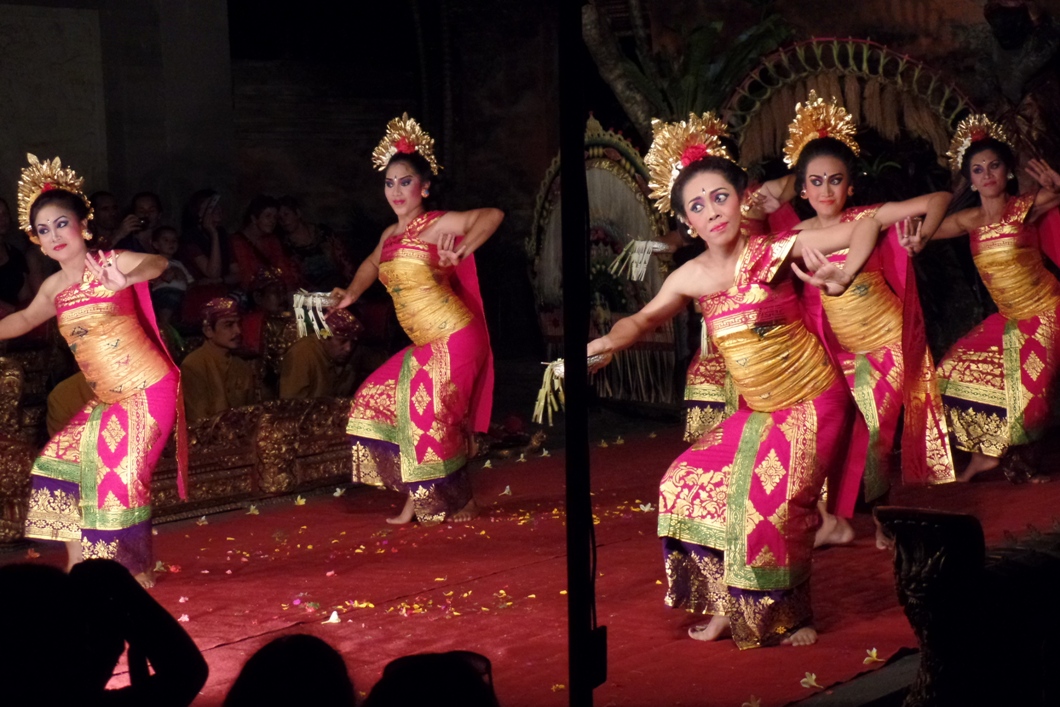
In the evening we went to see some traditional Balinese dancing at to the Ubud Palace. It was a slightly expensive affair which we knew we were only going to be able to squeeze into our budget once, so, we decided to see one of the classics: the Legong dance.

???????????????????????

Balinese dancing is very expressive. If you ever observe one and watch closely you will notice that every little nuance such as the bending of a single finger, the rolling of an eye, or the slightest change to a facial expression, are all very deliberate things which the dancers use to convey meaning. The music was all created live by a group of men clanging away at their percussive instruments with hammers and sometimes making drawn out vocal sounds.

???????????????????????

The next day we went to see some of the religious sights which were a bit further afield. In the morning we visited Go Gajah and Yeh Pulu; both of which were fairly interesting but nothing spectacular. What was more enjoyable was the short walk along a ravine which ran between the two sites.

???????????????????????

In the afternoon we ventured up to Tapaksiring to see more temples. Gunung Kawi, which is regarded as one of the island’s most important sites, had some pretty impressive shrines carved into niches of a large rock face.

???????????????????????

It was also surrounded by some very picturesque rice terraces.

???????????????????????

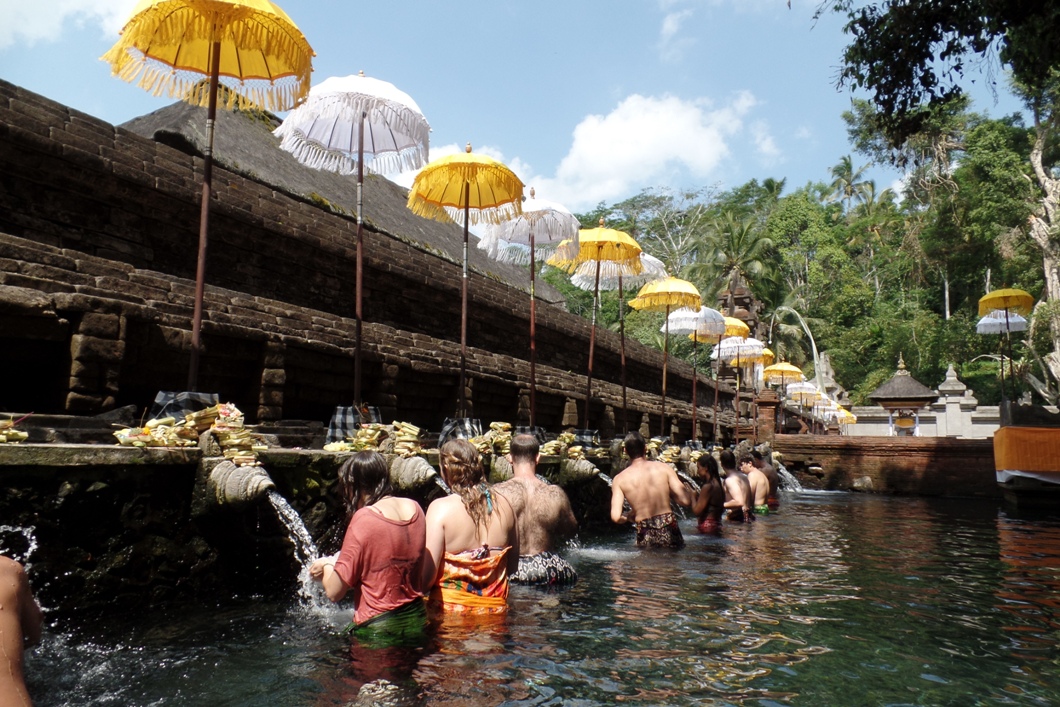
Later on we went to Tirka Empul; a holy spring which is very sacred place to the local people. Visitors are allowed to bathe in one of the temple’s pools (as long as they are willing to wear one of the communal sarongs which are handed out), and it was a rather refreshing way to finish off the afternoon.

???????????????????????

We then went back to our lovely little chalet. Where we sat on the balcony and drank a beer while planning where we were going to move on to next.

???????????????????????

More photos (taken with my brand new camera) can be found here.

Travelblog#14: Farewell Burma – Highlights and Reflections

Burma has been a special place to me, and almost definitely my favourite country in the mainland of SE Asia. Therefore, I have decided to write a little something extra now that I have left. Here are the top Five Highlights from my trip:


#5 Hsipaw

It is a shame that all of the longer treks were forbidden while I was there and I hope that the warring in that region ends soon, but the fact that Hsipaw was still one of my favourite places has got to mean something. The town itself was my favourite town in the whole of Burma, and there were many little attractions nearby which make great day-tripping opportunities. The surrounding scenery of rice paddies, mountains, farms and Shan villages are, quite simply, stunning. Visitors should also try and make time for visiting Fern at the Shan Palace for a history lesson.

2


#4 Hiking from Kalaw to Inle Lake

Okay, so we got scammed by the Singh brothers when we booked the trek, but we managed to turn it around and still have a wonderful experience. Three days of walking through a landscape of picturesque Shan hills and tribal villages is a great way to reach Inle lake, and the nicely cool climate is also a bonus.

6


#3 Climbing Mount Zwegabin

It was a sweat-inducing, exhausting climb, and the mosquitoes feasted on me that night when I slept at the monastery, but, Burma has many holy mountains, and this has got to be my favourite one. Not many people seem to go there either.

 header


#2 The South

The areas around Mawlamyine and Hpa-an, where we spent our first week in Burma, still have this rawness about them which make them very rewarding for travellers. Many of the locals there are still excited to see foreigners and are keen to converse with them. Hitchhiking was easy (and often necessary, as there wasn’t much public transport) because the people were so friendly and helpful. This is definitely an area which is yet to become jaded by tourism.

2


#1 Bagan

It took us a while to “get” Bagan because the temples were a little bit samey, but once you manage to get up from a high vantage point and see views like this:

3

You’ll begin to understand. I think that visiting Burma without going to Bagan would be a bit like going to Cambodia and not seeing Angkor Wat – it’s just not done!


Here are some of my other favourite things about Burma:


Chinese Tea

Is basically free. Whenever you are having breakfast in a teahouse, dinner in a Myanmar restaurant, or just a quick spot of lunch in a café, you’ll often have a pot of hot Chinese tea and a few small cups placed in front of you. You can drink as much of it as you want and they just keep filling it up again!


The People

Are possibly the friendliest in Asia. I spoke of this in more detail in my Bagan blog, but Burmese people are still in a place where they are generally enthusiastic about having foreigners visit them because they didn’t have much of a connection to the outside world before. So, when they approach you; don’t worry! They’re probably not trying to scam you, they just want to talk!


Journeys

Whether it was a bumpy train ride to Hsipaw, seeing beautiful villages while walking to a cave temple, being driven through scenes of rural life along the Shan plateau, or maybe even just listening to some old man’s life story while hitchhiking in his truck, one of the things that I have definitely noticed about Burma is that the journey there was often just as interesting as the destination itself.


But overall, my favourite thing about Burma is that there is still much more to explore. It is a big country and there are parts of it which are currently inaccessible because of in-fighting and lack of public transport. It is also a country which is evolving, due to both its slow journey into democratisation and the coming of outside influences such as tourism. There are jungles which are home to species which are extinct in the rest of Asia, and I hope very much that they are turned into a national parks before corporate interests tear them down. There is Mrauk U; another temple complex which is supposed to rival Bagan, but at the moment it is expensive to get to. There are islands in the south which are probably even more beautiful than Thailand’s because they are still untouched.

And all of these places will probably become more and more accessible as Burma changes. I think this is definitely a country that I am going to return to one day…

Travelblog#13: Mandalay, a boat to Katha, & being ill in Yangon – My last week in Burma

19th-25th September, 2014

Mandalay was a bit “meh”, but we had suspected as much. We had already decided that it was a place we were just going to pass through so as soon as we arrived there we went straight to the jetty and booked a boat heading upriver for the following morning.

This still left us with an afternoon to entertain ourselves in Mandalay. So, what did we do?

We caught a bus out of Mandalay. To a town just outside of it called Amarapura, so we could see the famous U Bein bridge.

2

At 1.2 kilometres long, it is the longest teak bridge in the world. I happened to notice though that a section in the middle of it is actually made from concrete, which I think is technically cheating. It was nice to sit there for a while and watch local life at Taungthaman lake roll by, with the fishermen out on the water and children playing.

1

The next morning we got up at 5 am and boarded the boat to Katha. It was quite an enjoyable journey, at first. The wooden seats were a bit crammed and uncomfortable, but the scenery around the Irrawaddy river was pleasant.

3

We were expecting the boat to be a bit late – we were in Burma, after all – so, when the woman who sold us the tickets told us we would arrive in Katha by 9pm, we took it with a pinch of salt. We thought that it probably meant we would be there by around 10pm, or maybe even 11 or 12.

We were not at all prepared for the idea that we wouldn’t be arriving into Katha until 5am the next morning. And by that point we were very tired.

Weary, frustrated, and sore from the hard seats we had just spent 24 hours sat upon, we were feeling a bit fed up by the time we found a guest house and crashed into our beds. We slept for a few hours, washed, and then began to explore Katha later that morning. It was quite a nice place, and we ended up staying there for two days.

4

There wasn’t anything incredible to see in Katha; it was just quiet river town at the end of the day. But it was a nice place to kick back and relax for a while, and the locals were all very welcoming and friendly. The entire time we were there there was no electricity. When we asked how long this power cut had been going on for they would just shrug and say; “Five days? I think….” and you could tell from the way they said it so nonchalantly that it this was a regular occurrence for them.

5

When we were beginning to think about moving on we noticed that there was a ticket booth by the side of the river, selling seats for boat running back downstream to Mandalay.

“Why is it so expensive?” we asked when they told us the price. It was the same amount we paid two days ago for the hideous journey we took upstream, and we knew by then that it was a complete rip-off.

“It’s an Express boat,” they said. “It only takes sixteen hours.”

That is exactly what they said to us two days ago… and there was no way we were going to fall for that trick again.

So instead we caught the sleeper bus. It was half the price, took half the time, and turned out to be a bit of an adventure in itself.

6

Half an hour after leaving Katha the bus reached this little obstacle, and all passengers were asked to exit the vehicle so that they could cross the bridge by foot.

Thinking that there was obviously going to be a new bus waiting for us on the other side, I began to pack away my things, but, by the time I had finished filling my bag I realised that I was the only one still on the bus. Apart from the driver who had started up the engine again.

“Wait!” I said, rushing down the aisle.

The driver turned, and his eyes widened when he realised that there was someone still on the bus. After a moment of consideration, he then shrugged, gestured for me to sit back down, and carried on driving.

A little confused, I did as he requested.

He then began to drive towards the river.

No… He’s not… I thought, as he steered the bus down the bank. He can’t possibly be…

7

Meanwhile… Roy was outside, on the bridge. He was a little confused as to how I managed get away with staying on the bus during this manoeuvre. Apparently, when he saw what the bus was about to attempt (with me on it, no less) he was a little bit concerned, but this didn’t stop him taking lots of photos.

9

We spent the next day in Mandalay again while we were waited for another bus to take us down to Yangon. We visited many of the main sites this time, including Mahamuni Paya and Mandalay Hill. Both were nice, but I have seen grander temples and holier mountains with much more stunning views, in other parts of Burma. I left Mandalay that evening, still not quite understanding why it is one of the countries’ main tourist attractions– apart from that it is, maybe, just a convenient enough location for travel agents to throw it into package tours.

That night on the sleeper bus, I began to feel a bit ill and I thought I had a bit of a temperature, but I told myself it was probably just tiredness. Roy and I had travelled over 800 miles in the space of four days, after all, and most of it had been overnight.

The next morning, shortly after we checked into a guesthouse in Yangon, I was aching all over and I began to feel feverish. I realised then that I really was ill.

I went to reception and asked to upgrade to a room with a double bed and air conditioning, and they were very helpful and understanding. They even, in my weakened state, helped me move my things.

I spent most of that day in bed, but I couldn’t sleep. Every time I closed my eyes I was getting those weird dreams you get when your feverish. Eventually, Roy returned with some food, medicine, and a thermometer. I took my temperature and it was 39 degrees, which was slightly worrying but nothing to panic about. I had already looked up the symptoms for malaria and dengue, and I didn’t have enough of the signs for either of them to cause immediate concern. I was also coughing and sneezing a lot which was more of an indication that I had the flu.

I made a resolution though: if I began to get cold sweats, pain behind my eyes, or my temperature went up to 40, I would go straight to the hospital.

Luckily none of those ever happened. I must have somehow got to sleep eventually, as well, because I woke up the following morning at 4am, feeling better. I took my temperature again; 38.

I managed to make it out of the hotel to eat breakfast and dinner that day, but I was still too weak to venture out too far. It wasn’t until my third day there that I finally got to see some of Yangon, and that was our last day in Burma.

We caught the circular train, which took us on a rickey and bumpy ride around the city. We got off three hours later on the eastern side and took a little walk around Kandawgyi Lake before we went to see Chaukhtatgyi Temple, which was home to one of the more charming large Buddha statues that had seen of late.

10

We then tried to get in Shwedagon Paya, but we found out that the Government had hiked the foreigner entrance fee up to $8 and we thought that was a bit in bad taste, as it is supposed to be a religious site, so, we walked around it and searched for way to sneak in. We managed to slip in through one of the side entrances, but the ticket Nazis eventually found us and we were escorted from the premises.

11

So, we went back to downtown Yangon and ate an Indian thali, and when we were suitably stuffed we began to make our way back to our hotel.

I saw a white guy walking down the street.

“Hey, dude,” I said, walking over to him. “Do you want this?”

I held up our (rather battered) copy of Lonely Planet Burma. “It’s a bit old,” I added. “But we’re flying off tomorrow and we don’t need it anymore. You can have it if you want.”

“Yeah. Sure,” he said, smiling as he accepted it. “Where you guys going, anyway?”

“Indonesia.”

“Niiiice.”